








Cast vs. Forged Pistons — What’s the Better Choice for Your Build?
Here at REV6, one of the most common questions we hear is:
“Should I go with cast or forged pistons?”
“If forged pistons are stronger, why do you guys still offer cast?”
It’s a great question — and the answer depends entirely on your setup, riding style, and what kind of abuse your engine is going to take. Let’s break it all down so you can make the right decision for your build.
What’s the Difference?
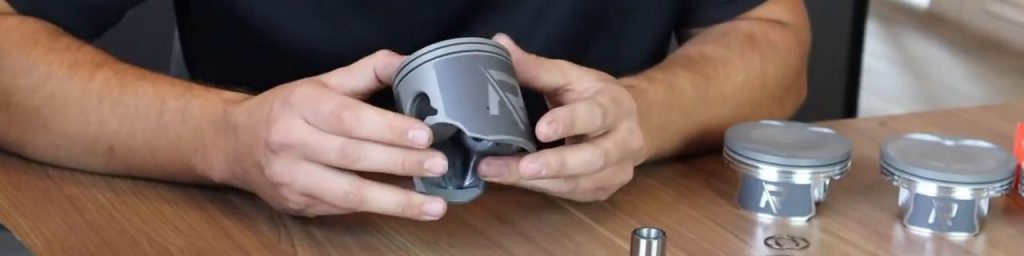
Before we jump into which piston is better, let’s talk about how they’re made — because that’s where the core difference lies.
Cast Pistons
- Process: Made by pouring molten aluminum into a mold.
- Grain Structure: More porous and spaced out.
- Common Use: Stock engines, OEM applications, mild upgrades.
- Advantages: Lightweight, lower expansion rate, quieter operation, and more cost-effective.
Don’t let the word “cast” fool you. These aren’t cheap throwaway parts — modern cast pistons are durable, well-engineered, and made from advanced aluminum alloys with silica content for strength. They’re used in nearly all factory engines because they perform well under typical riding conditions.
Forged Pistons
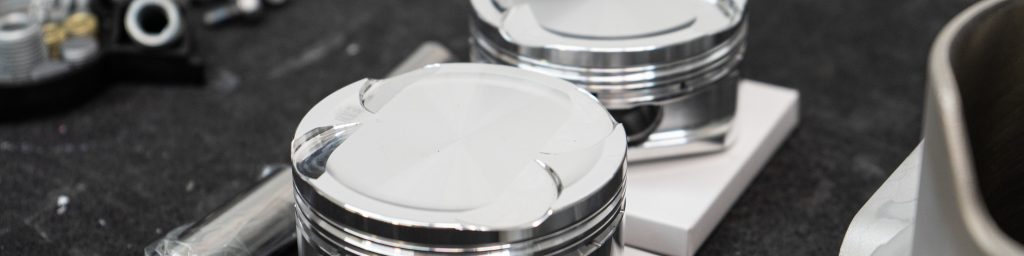
- Process: Formed by compressing a solid aluminum billet under extreme pressure and heat.
- Grain Structure: Dense, tight, and uniform — significantly stronger.
- Common Use: High-performance, racing, turbocharged, high-compression, or big-bore engines.
- Advantages: Much stronger, handles extreme stress, better resistance to detonation, deformation, and high cylinder pressure.
Forged pistons are the go-to for serious power builds. The forging process gives them structural integrity that holds up in harsh environments — whether that’s high heat, boost, nitrous, or big revs.
So, Why Does REV6 Use Cast Pistons in So Many Builds?
Simple: because they work extremely well — when matched to the right engine.
Most of our customers are building for trail riding, hunting, utility use, or casual performance. In these applications, a cast piston provides better long-term durability with less noise, less heat expansion, and better compatibility with factory cylinder tolerances.
Not to mention, cast pistons are:
- More fuel efficient (lighter rotating mass)
- Easier to tune (less sensitive to heat and clearances)
- Quieter (less piston slap at startup)
- Longer-lasting in moderate conditions
They may not be as strong under extreme pressure as forged pistons, but they’re often more reliable in standard conditions because they don’t expand as aggressively or require loose tolerances.
When Forged Pistons Are the Right Call
If your build is going to live in the red zone — boosted, high compression, big bore, or race-prepped — cast pistons aren’t going to cut it. This is where forged pistons shine.
They’re built for:
- Turbo & supercharged engines
- High-RPM rev limits
- Race fuel or nitrous setups
- Heavily tuned or aggressive timing curves
- Sand drag, dune, or desert builds
Forged pistons resist cracking, stay together under detonation, and won’t fail when things get hot — literally. But they do come with tradeoffs:
- Heavier than cast, which can reduce rev speed slightly
- Expand more when hot, which can cause cold-start noise (piston slap)
- Require a looser piston-to-wall clearance, which must be carefully measured
So while they’re stronger, they also require a higher level of precision and awareness in how the engine is built, broken in, and tuned.
The Myth: Stronger Means Better
It’s easy to assume “forged is better” just because it’s stronger — but in the engine world, that’s not always the case.
Reliability = the right part in the right application.
A forged piston in a mild-trail motor might actually cause more problems than it solves — cold seize, excessive noise, or ring sealing issues due to expansion. Likewise, putting cast pistons in a high-boost engine is a guaranteed failure waiting to happen.
Final Thoughts
At REV6, we don’t just build engines — we build solutions based on how you actually ride. Cast pistons aren’t “cheaper alternatives” — they’re the correct and most reliable choice for stock and moderately tuned builds. That’s why most factory engines run cast. They offer excellent durability, less wear, better heat control, and overall longevity in real-world use.
Forged pistons are purpose-built for performance and should be used when you’re running an engine hard — higher cylinder pressure, heat, and abuse demand the extra strength. But they do require more careful setup and tuning.
Need help choosing the right setup for your machine? Reach out to our team or explore our blog for more powersports tips and engine insights.
Nationwide shipping, veteran discounts, and trusted builds backed by warranty — that’s the REV6 difference.