










ECU Tuning Explained: What It Does, Why It Unlocks Hidden Power, and How It Can Actually Improve Reliability
Modern UTVs and ATVs are not limited by hardware. Instead, they’re limited by calibration.
From the factory, your machine leaves with conservative ignition timing, rich fuel tables, torque limiters, airflow modeling restrictions, and throttle logic designed to survive the worst possible fuel, the hottest possible desert, and the least mechanically sympathetic owner imaginable.
In other words, manufacturers don’t tune for performance. Rather, they tune for warranty survival. As a result, substantial performance potential is intentionally left on the table.
That’s where ECU tuning comes in.
What Your ECU Controls
To begin with, your ECU controls:
- Fuel delivery
- Ignition timing
- Throttle mapping
- Torque modeling
- Rev & speed limiters
- Cooling fan activation
- Injector scaling
- Boost control (turbo models)
- Idle logic and decel behavior
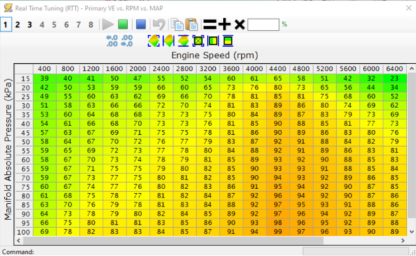
Every one of those tables is adjustable. However, from the factory, they’re intentionally conservative. For example, timing is typically calibrated conservatively from the factory. Likewise, fueling is richer than optimal. In addition, torque tables artificially cap output, throttle curves are lazy, and speed limiters exist purely for liability reasons.
Therefore, tuning recalibrates those tables to:
- Optimize combustion efficiency
- Improve throttle response
- Increase usable torque
- Remove artificial restrictions
- Stabilize air-fuel ratios under load
- Control heat more effectively
Importantly, done correctly, tuning does not “push” the engine harder. Instead, it allows the engine to operate closer to its actual engineered potential.
Why There’s So Much Power Left on the Table
To understand why, manufacturers must account for:
- Low-octane fuel
- Extreme heat
- High altitude swings
- Poor maintenance
- Emissions compliance
- Global market calibration requirements
Consequently, one conservative map must work everywhere.
Your machine, however, is not operating in a global test cell. Instead, it’s operating in your climate, on your fuel, and with your specific setup.
When you optimize:
- Spark advance
- AFR targets
- Throttle torque modeling
- Load calculations
You unlock efficiency. As a result, efficiency equals power.
For example, most naturally aspirated UTVs can gain:
- 5–10 HP with optimized stock calibration
- 10–20 HP with exhaust + calibration
- 20+ HP with airflow modifications and precise fuel/timing control
Meanwhile, turbo models gain even more because boost control and ignition timing under load are heavily restricted from the factory.
Can ECU Tuning Be More Reliable?
This is where people get confused.
On one hand, bad tuning destroys engines. On the other hand, good tuning protects them.
Specifically, proper calibration:
- Eliminates lean spikes
- Prevents detonation
- Controls combustion temperatures
- Lowers unnecessary exhaust heat
- Improves cooling fan logic
- Removes erratic torque management intervention
Factory tunes often run overly rich in some areas and oddly lean in others due to emissions constraints. Consequently, that inconsistency creates heat instability.
By contrast, a well-built calibration stabilizes AFR targets and spark timing so combustion is predictable and repeatable. Therefore, predictable combustion equals reliability — especially on modified engines.
REV6 POWERSPORTS TUNING
Most tuning companies sell preloaded “canned” maps — one-size-fits-all files that are copied, slightly modified, and sent to everyone.
As a result, that approach:
- Ignores build differences
- Ignores fuel variations
- Ignores altitude
- Ignores injector scaling
- Leaves torque tables partially untouched
REV6 does not operate that way.
Instead, every REV6 ECU tune starts from your actual stock ECU file. Then, it is rebuilt line by line to match your specific machine, setup, and riding style.
This is true calibration — not a template modification.
Furthermore, REV6 tuning engineers apply the same engineering principles used in the REV6 engine building division, where some of the strongest UTV and ATV engines in the country are built and warrantied.
As a result, you get:
- Smooth, predictable power
- Massive throttle response gains
- Stable air-fuel ratios
- Safe combustion timing
- Real-world reliability
HOW IT WORKS
- First, order your tune.
- Next, we ship you a REV6 TDN Device + Link Cable.
- Then, plug into your machine and download the TDN App.
- After that, hit “Read Vehicle.” The app automatically sends your stock file to our tuning department.
- Within 24–48 hours, we send your custom tune back.
- Finally, flash your ECU and feel the difference.
When purchasing, send the following to tuning@rev6sports.com:
- Full Name
- Email and Phone Number
- Year, Make, and Model
- Desired Tune Stage
- List of Current Upgrades
REV6 PRICING
$750 Total — Includes Hardware + Custom Tune
Return Option:
Send the TDN device back for a $250 refund. As a result, the final cost becomes $500.
Keep It:
Alternatively, retain the device for future updates, data logging, and real-time monitoring from your phone.
WHAT MAKES REV6 DIFFERENT
- True Custom Files: Your ECU file is rebuilt using HP Tuners’ latest software. Not modified. Rebuilt.
- Performance + Reliability: Power without detonation, lean spots, or heat spikes.
- Factory-Level Control: Throttle, torque, fuel, timing, cooling, limiters, idle logic — rewritten from scratch.
- Fast Turnaround: 24–48-hour delivery.
- Backed by Engine Builders: The same team that builds and warranties Polaris, Can-Am, and Yamaha engines handles calibration limits.
That matters.
STAGE OPTIONS
STAGE 1 — +5–10 HP
For: Stock or lightly modified machines
Ideal Use: Trail / Utility / Everyday Riding
Includes:
- Sharpened throttle response
- Cooler fan activation temps
- Increased speed & rev limiters
- Raised torque limits
- Optimized fuel and ignition maps
- Smoothed throttle transitions
Result:
Stronger midrange pull, cooler operating temps, improved drivability without added stress.
STAGE 2 — +10–20 HP
For: Slip-on or full exhaust systems
Ideal Use: Performance Trail / Dune / Desert
Includes:
- All Stage 1 features
- Lower cooling fan temps
- Removed seatbelt & speed limiters
- Raised throttle and torque ceilings (safe thresholds)
- Adjusted misfire detection
- Enhanced timing & fueling for high-flow exhaust
Result:
Aggressive throttle response and real top-end power. It feels like a different machine.
STAGE 3 — 20+ HP (Build-Dependent)
For: Big bore kits, cams, turbo systems, full engine builds
Ideal Use: Race / High Performance
Includes:
- Fully custom-tune built from your ECU data
- Optimized fuel, timing, and torque tables
- Boost-safe ignition calibration
- Custom AFR targets & injector scaling
- Individualized torque model tuning
- Optional data-log review and refinement
Result:
True race-level calibration matched to your exact build.
SUPPORTED MODELS
WHY REV6 TUNING WORKS
Most competitors bump a limiter and call it a stage upgrade. However, REV6 rewrites:
- Torque tables
- Airflow models
- Ignition maps
- Throttle logic
- Cooling thresholds
- Combustion safety margins
The goal is not dyno-sheet bragging. Instead, the goal is usable, stable, repeatable power.
Every REV6 calibration is validated on live data, not marketing claims.
TECHNICAL DETAILS
- Software Platform: REV6 HP Tuners VCM Suite / TDN Integration
- File Delivery: Direct TDN Upload via TDN App
- Format: OEM Binary-Based Custom Calibration
- Turnaround: 24–48 Hours
- Refund: $250 upon device return
ECU Tuning FAQ
What is ECU tuning for a UTV or ATV?
ECU tuning recalibrates fuel delivery, ignition timing, throttle response, torque limits, and cooling logic so your machine operates closer to its engineered potential instead of a conservative factory map.
How much horsepower can ECU tuning add?
Most naturally aspirated UTVs gain 5–10 horsepower with optimized stock calibration. With exhaust upgrades, gains typically increase to 10–20 horsepower. Turbo models often gain even more.
Does ECU tuning improve reliability?
When done correctly, custom ECU tuning improves reliability by stabilizing air-fuel ratios, reducing detonation risk, and controlling combustion heat.
Is a custom tune better than a canned tune?
A custom tune is built from your specific ECU file and calibrated for your machine and upgrades. Canned tunes use generic templates that may ignore injector scaling and torque limits.
Do I need ECU tuning after installing a turbo or big bore kit?
Yes. After adding airflow or boost, recalibration is essential to prevent lean conditions and excessive heat.
Is ECU tuning worth it on a stock machine?
Yes. Even stock UTVs benefit from improved throttle response, smoother torque delivery, and optimized cooling logic.
Final Thoughts
If you’re building serious engines, you already know hardware is only half the equation.
Airflow without calibration is wasted potential.
Fuel without spark optimization is heat.
Boost without torque modeling is broken parts.
Therefore, ECU tuning, done correctly, is not a shortcut. Instead, it’s the final step that allows the mechanical components to actually perform the way they were designed to.
And if you’re already investing in engines, clutching, transmissions, or big-bore builds, leaving the stock calibration untouched is like building a race motor and breathing through a straw.